

Irony
Kierkegaard is considered a Christian writer, but he studied the Pagan philosopher Socrates in his earlier works. He incorporated Socratic ideas throughout his career and body of work. The main idea that Kierkegaard takes away from Socrates is the concept of irony, which is also the title of his master’s thesis. An individual practicing irony adopts a negative stance toward an issue. In other words, when an individual takes a negative stance on an issue or engages with an interlocutor, they assume a ‘not knowing’ position. In this state, they avoid offering solutions or advice, opting instead to ask questions based on rational logic to uncover the underlying truths of an issue.
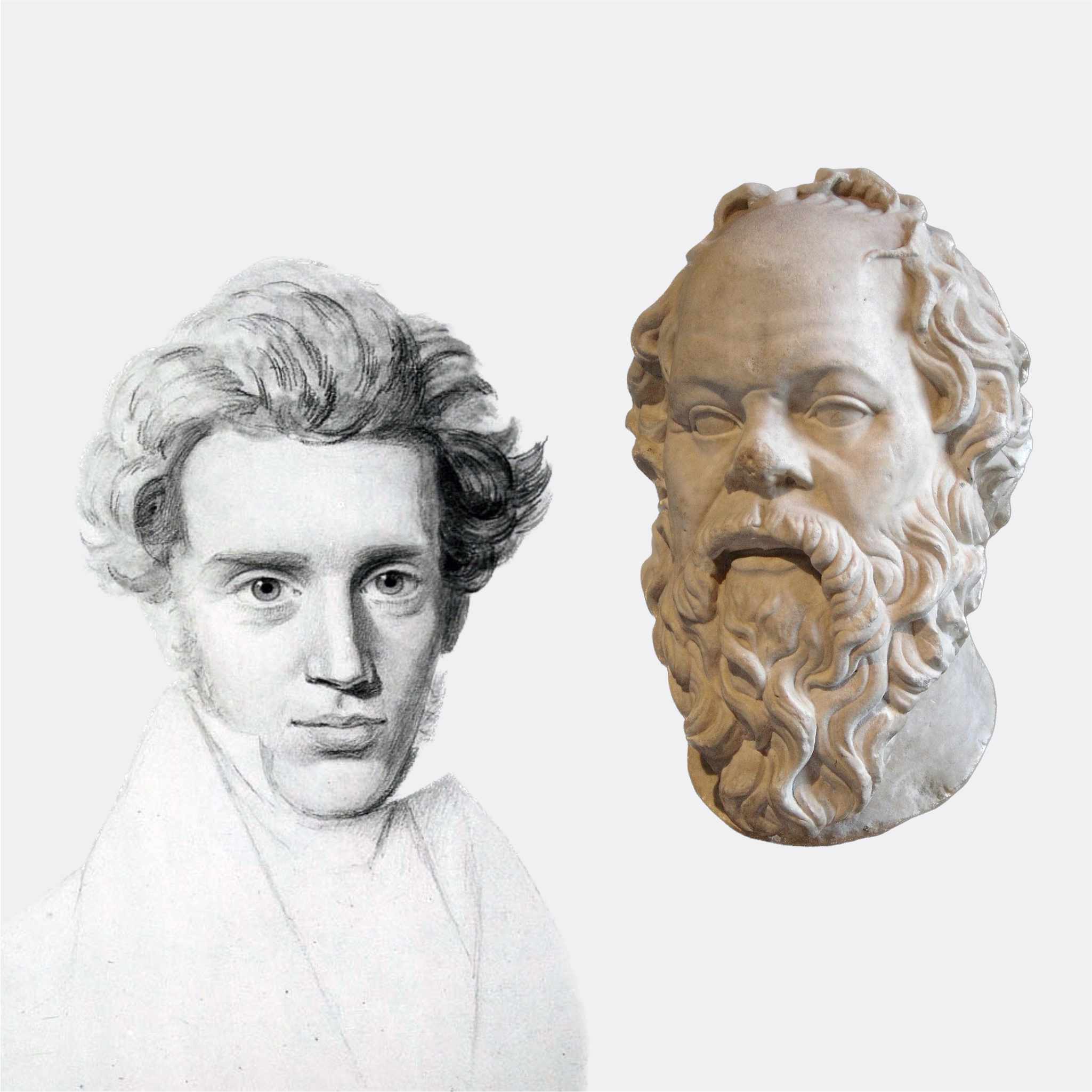
Socrates described the Sophists of his time, who acted as experts, mentors, and tutors, and were paid for their knowledge. Although the Sophists displayed confidence in their superior knowledge, Socrates used irony to reveal flaws in their supposed expertise.
Through irony, Socrates describes the practice of midwifery. Midwifery is based on the idea of assisting others in arriving at their own conclusions. Notably, this illustrates the usefulness of having a negative sounding board available to you. This reminds me of the Person Centred Approach of Carl Rogers.
Aporia
In his examination of Socrates, Kierkegaard acknowledges that the use of irony also leads the interlocutor to a state of aporia. Aporia is the experience of a sense of loss or a moment of grappling. Aporia occurs when the interlocutor becomes aware of the cracks in the foundation of their knowledge. That is to say, continuing to apply irony or the negative method reveals gaps in the interlocutor’s initial belief in their expertise.
While aporia feels uncomfortable for the interlocutor, it is a productive state as it allows them to address gaps in their knowledge and move towards new meanings.
Daimon
Socrates also had his own Daimon, which he described in a spiritual sense as a form of intuition. The Daimon is a negative force that would caution him whenever he was about to undertake something inappropriate. In Athens, inventing new spiritual deities was prohibited; individuals had to consult oracles that guided the public and society at large. The practice of individual spirituality was condemned.
Socrates described himself as the Gadfly of Athens, believing his purpose was to practice his negative method in society. Socrates’ use of irony and personal intuition was powerful, uncomfortable, and a threat to the prevailing way of life in Athens at the time. In fact, his ideas led to his demise.
The relevance of irony in the world today
Postmodern philosophy and existentialism deal with the lived experience of the modern individual. The world and modern way of life continually change due to social mega-trends like globalisation and technological innovation. Consequently, these modern mega-trends result in rapidly changing was of life.
Meaninglessness
Kierkegaard attributes the sense of purposelessness experienced by the modern individual to these rapid changes in society. The constant influx of new information results in a subjective experience of nihilism and ultra-relativism, associated with feelings of meaninglessness.
Kierkegaard’s relevance endures after his time, influencing philosophers and psychologists like Nietzsche and Freud, who would dramatically change the world as we know it. The tools and techniques of Socrates that Kierkegaard sheds light on offer a means to diagnose and address the threats to our experience of authenticity (meaninglessness).
Meaning making
Kierkegaard’s negative techniques are practical solutions to nihilism and facilitate the search for meaning. Through irony, individuals can turn to introspection to find ideas worth living and dying for, making choices aligned with their true purpose.
Every person needs to discover this individually, a pursuit Kierkegaard termed the Socratic task. In summary, by practicing our Socratic task, we can live by our own ideals rather than someone else’s.
Kierkegaard doesn’t advocate objective truths or rules; he offers tools to help us find our personal truth.
For further reading, refer to the below resources:
