

Here’s how to design an effective study plan for the CFA’s Certificate in ESG Investing.
What is CFA’s Certificate in ESG Investing?
CFA offers a certificate on the application and integration of Environmental, Social, and Governance (ESG) factors into financial instruments, with a major focus on investments.
Why pursue the Certificate in ESG Investing
ESG is gaining more focus and its integration can be used to reduce risk while enhancing returns over the long-term. ESG stands for Environment, Social and Governance. Here are examples of the importance of each of these factors:
- Environment: Climate change presents the next significant global challenge.
- Social: Considers the positive and negative impacts of business activities on society.
- Governance: Concerns the management and oversight of companies.
How does the ESG Certificate compare to the official levels?
Pressure is a privilege. – Billie Jean King
The official CFA levels are known to be demanding. I admire those who choose to strengthen themselves through the CFA process. This inspires me to do more via the CFA Institute.
In comparison, the Certificate in ESG Investing is much less demanding and challenging than the official levels. The certificate requires about 100 hours of study and must be completed within a 6-month period from the time of payment.
How to prepare for CFA’s Certificate in ESG Investing
The exam format will dictate your study approach. Therefore, the first step in developing a strategy is to understand the exam format:
- The exam has 100 multiple-choice questions.
- I took the exam at a Prometric center, and I received my result immediately after completion. My badge and certificate were sent within 24 hours. Kudos to the CFA Institute! (View my badge below)
- There are numerous acronyms, details of regulatory codes and bodies, and specifics about the governance principles of different countries that can be challenging to remember but important to know.
- The material covers a lot of theory and facts which requires memorisation, for example knowing the Stockholm Resilience Centre’s 9 planetary boundaries and which have and have not yet been crossed.
- Understanding the concepts in the textbook at a general or high level is important but will not be enough to pass. It’s crucial to develop a thorough and deep understanding of the material and to know specific nuances.
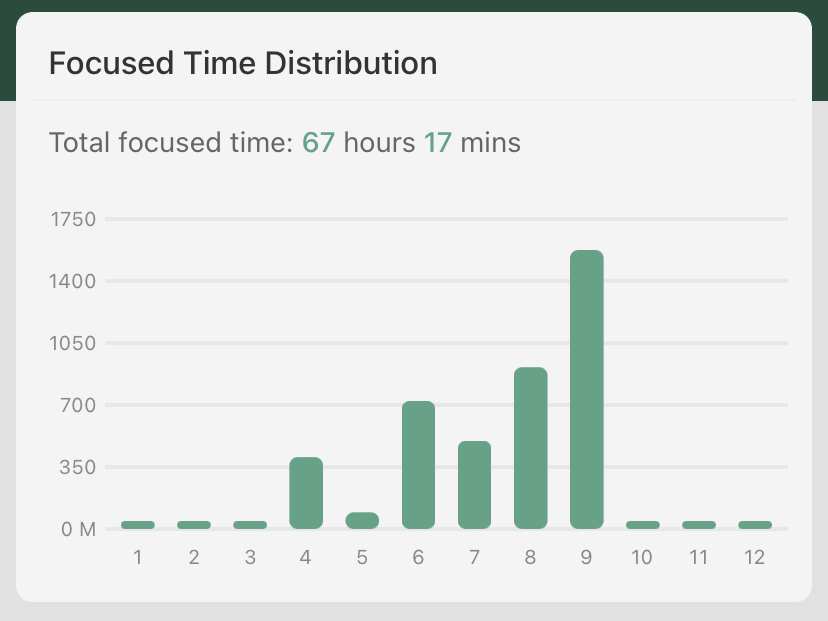
- I studied for a total of 67 hours, which I found to be sufficient. Your experience with the material may differ, so adjust your study time accordingly.
View my credential:
https://credentials.cfainstitute.org/442ed610-f82b-480e-958c-5c1bcbd323af
The amount of time I spent on studying, tracked using Forest:
Six tips for designing a strategy for studying
- Firstly, go through the material to gain a solid understanding. Since many concepts were new to me, I reviewed the material 3-5 times. I read through the content, highlighted important information, made notes, and created flashcards. I didn’t end up using my flashcards extensively, but I did find one-page summaries of the most crucial information from each chapter useful, like I mentioned above, there are many lists and facts to memorise.
- Complete end-of-chapter questions (without referring to the book). Midway through, I realised that the end of chapter questions are also available on CFA’s Learning Center. I found the Learning Center to be useful, mainly for the question bank. It allows you to practice questions and assign a confidence score to each answer. The dashboard displays your marks for each chapter and your level of proficiency. You can use these insights to identify and address your weaknesses.
- If you want more practice questions, consider using an official provider. I used Alma Mundus for additional practice questions and passed on my first attempt. There are other providers available; check the CFA website for a list of official ones.
- Don’t underestimate the value of memorisation! Unfortunately, you can’t escape this step. There are numerous lists to memorise, which will help you remember how concepts fit together during the exam.
- Once you feel confident enough, take the mock exam, also available on CFA’s Learning Center. Do this at least 2 weeks before the exam so that you have enough time to focus on your weak areas and work on strengthening them once you get your result.
- Finally, share your experience with someone else who is studying for the same exam. Discussing your experience can reduce stress and help you clarify difficult concepts.
Is the certificate in ESG Investing useful for career progression?
The real work begins after you receive your certificate. Now, you can start considering how to integrate ESG strategies into your work. You may never transition to a full-time ESG role, and that’s perfectly fine. If you’re interested in incorporating ESG, consider shifting your work toward ESG inclusion. For example, if you work in the investment industry, align your overall beliefs and philosophy with ESG principles. Think about how you can begin integrating ESG into your current processes, both in the short term and long term.
What I got out of this certificate
CFA’s Certificate in ESG Investing allowed me to:
- Broaden my understanding of ESG: environmental, social and governance risks are complex and interlocking.
- Understand the relevance and application of ESG across a variety of financial instruments.
- Distinguish between activities that extract value in the short term and those that preserve and enhance value in the long term.
- Understand how to facilitate change through stewardship and engagement and create value in the process.
- Recognise how integrating ESG can lead to better financial performance of companies.
- Know which adjustments analysts and portfolio managers can make based on good or bad ESG performance.
- Familiarise myself with steps involved to integrate ESG into the investment process.
