


What is leadership?
Leadership is a term often quoted in the workplace. Leadership is broadly understood from the employee’s point of view as something you should be engaging with to grow your career. But what does this mean for the individual and the organisation, practically speaking?
Leadership can be defined as the way in which you mobilise and influence others to achieve a goal. It involves goal-setting, decision-making and collaboration. Leadership is a socially constructed process and a practice that helps to humanise leaders which is key to achieving effectiveness in an organisation.
Leadership draws inspiration from psychological theory and represents an individual’s ongoing psychological journey. It emphasises the process of growth and adaptation, often accelerated by engaging experiences to expand one’s consciousness. Leadership is not a fixed end-state or ultimate outcome.
History of leadership and its foundations in psychology
Trait theory
Trait theory was one of several influential frameworks in early workplace psychology. These theories of personality were pioneered by Gordon Allport. They were designed to identify existing patterns of thoughts, behaviours, and emotions in the personality structures of individuals. The well-established Big Five Personality Traits model developed by Costa and McCrae is an example of the application of trait theory. Research in trait theory aims to understand how personality traits impact job performance.
Behaviourism
As leadership traits were defined, classified and studied, Behaviourists discovered that they could be emulated. From a behavioural point of view, leaders can be developed because behaviour can be learned. It is contingent on the environment and the behaviour of others. The environment plays a significant role. Context should always be considered. There is no standard set of traits that makes a good leader in every situation. Instead, leaders must be able to adapt to their context.
Behaviourism at a glance
- The main influencers of Behaviourism were BF Skinner, Albert Bandura and Joseph Wolpe
- The focus of Behaviourism is on observable behaviour, determinants of behaviour, learning experiences that promote change, scientific measurement, evidence based techniques.
- The 4 main areas of development in Behaviourism are classical and operant conditioning, social cognitive theory and cognitive behavioural theory.
Behavioural theory in leadership
In 1945, a group of researchers at The Ohio State University set out to identify the observable behaviours that leaders typically display. They developed two dimensions, namely consideration and initiating structure. Consideration relates to the quality of interpersonal relationships and trust, whereas initiating structure pertains to defining team members’ roles and initiating actions. The researchers assessed individuals using a psychometric self-disclosure questionnaire known as the Leader Behaviour Description Questionnaire (LBDQ), which classified individuals into one of four quadrants based on whether they scored high or low on consideration and initiating structure.
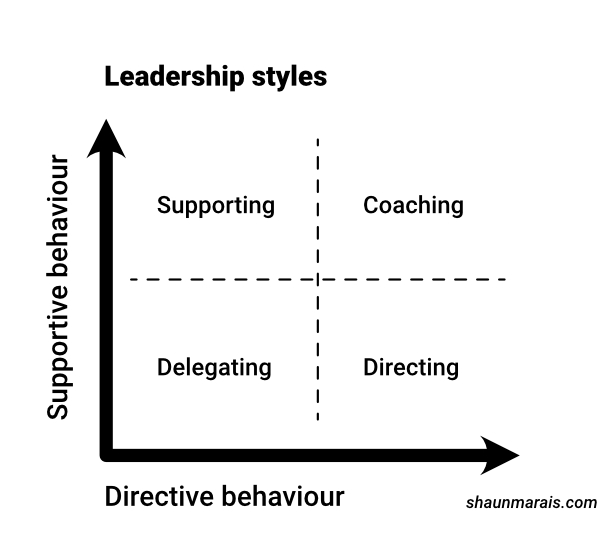
The Hersey-Blanchard Situational Leadership Model also defines tasks and relationships as key dimensions in the workplace. It outlines four distinct leadership styles—directing, coaching, supporting, and delegating—based on these dimensions. In this model, none of these styles is proposed as the ideal approach; rather, leaders are encouraged to adjust their level of support and direction based on the developmental needs of their team members.
Relational theories further evolved behavioural approaches to emphasize the quality of leader-member exchanges, focusing on the interactions between leaders, in-group and out-group members, and the broader organisation.
The transactional approach views leadership as an exchange and supports the idea that behaviour is shaped by consequences. Rewards and punishments are used to influence and guide behaviour.
Transformational theory is influenced by both behavioural theory and Abraham Maslow’s concept of self-actualisation. In the workplace context, this refers to achieving one’s full potential at work and connecting employees to a broader personal and organisational purpose. From a behavioural perspective, this approach involves being an inspiration to others. People tend to emulate and support leaders they admire.
The most important leadership competencies
In 2016, Sunnie Giles conducted an international study using a self-response questionnaire, asking leaders from around the world to rate what they believed were the most important leadership competencies from a broader list of 74. Giles grouped and categorised the results, identifying the top 10 themes that emerged. The goal was to identify universal competencies relevant to workplaces and industries globally. Although conducted in 2016, the study remains influential in shaping our understanding of leadership in the workplace.
| Strong ethics & safety | Has high ethical and moral standards |
| Self-organizing | Provides goals and objectives with loose guidelines/direction; Clearly communicates expectations. |
| Efficient learning | Has the flexibility to change opinions |
| Nurtures growth | Is committed to my ongoing training |
| Connection & belonging | Communicates often and openly Is open to new ideas and approaches; Creates a feeling of succeeding and failing together; Helps me grow into a next-generation leader; Provides safety for trial and error |
A guide to understanding and supporting your team effectively
Sense > Sense-making > Acting is a guide that can be used to identify and meet the needs of your team.
- Sensing involves detecting how people are feeling so you can better identify problems early on. Not every team member communicates in the same way—knowing how to sense what is going on is a skill you need to hone.
- Sense-making involves collaborating with your team to fully scope out the scale of the problem and identify next steps.
- This is then followed by taking swift action through the execution of activities aimed at addressing the identified problem.
References
Benmira, S., & Agboola, M. (2021). Evolution of leadership theory. BMJ Leader, 5(1), 3–5. https://doi.org/10.1136/leader-2020-000296
Bisoux, T. (2024). Drive transformation with human-centric leadership. AACSB Insights. https://www.aacsb.edu/insights/articles/2024/07/drive-transformation-with-human-centric-leadership
Corey, G., Nicholas, L. J., & Bawa, U. (2017). Theory and practice of counselling and psychotherapy (2nd South African ed.). Cengage Learning.
Giles, S. (2016). The most important leadership competencies, according to leaders around the world. Harvard Business Review. https://hbr.org/2016/03/the-most-important-leadership-competencies-according-to-leaders-around-the-world
