

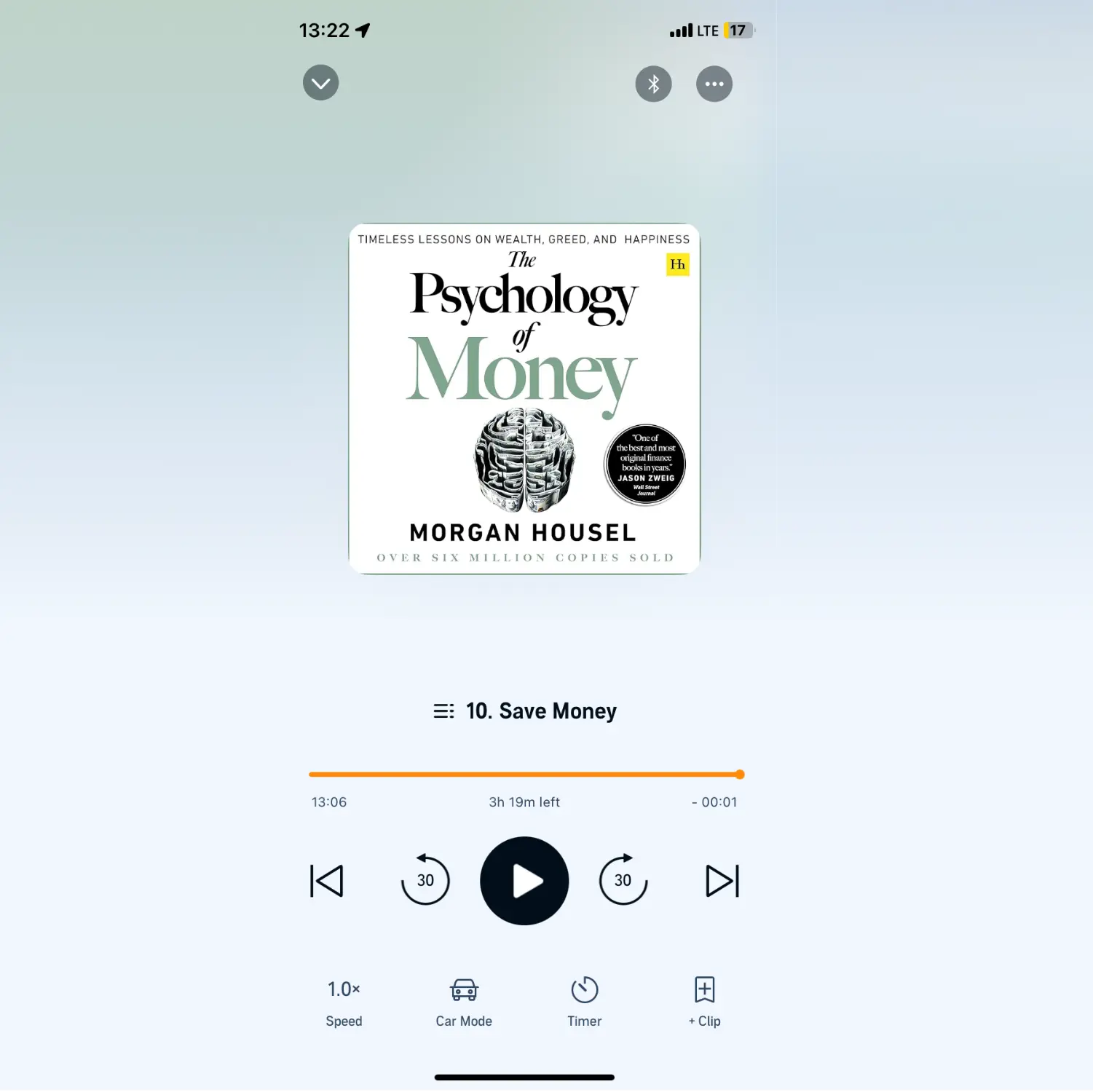
How I discovered The Psychology of Money
I recently listened to The Psychology of Money and found that it was a great audio book.
Having moved to Cape Town in December 2023, this means that I now need to travel a couple of times a year for work. I discovered that I prefer the privacy of listening to media on the plane over reading or watching something on my phone or carrying large books with me, especially when it comes to quick business trips. Not only are audio books the perfect format for travelling, I have also found that I can finish a short book during each of my round trips and make progress on my reading goals for the year at the same time. A major deciding point for choosing the right audiobook is that it shouldn’t be overly complicated (since I have previously made the mistake of listening to an intricate novel which caused me to lose the plot).
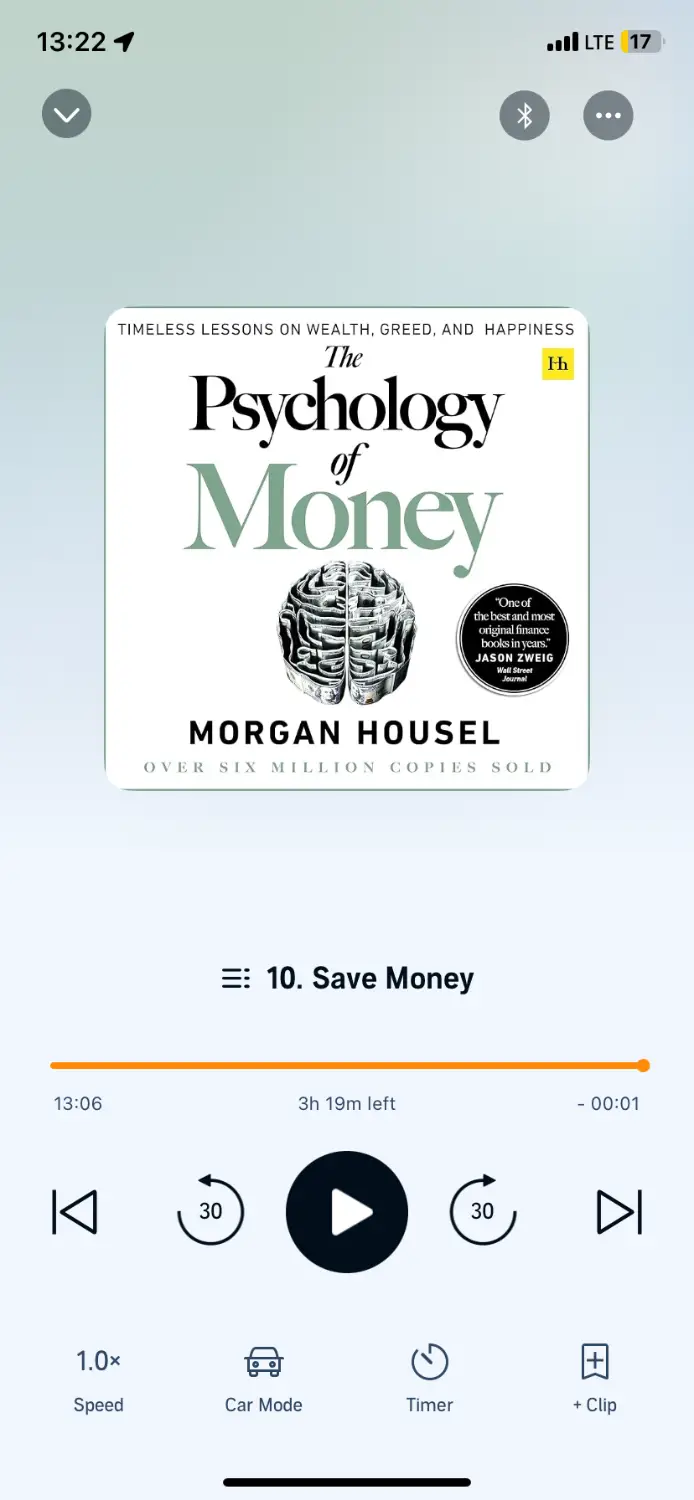
The version I listened to can be accessed on Audible via this link:
https://www.audible.com/pd/The-Psychology-of-Money-Audiobook/B08D9TXF3H
Purpose of the book
Morgan Housel combines two of my favourite genres into one in The Psychology of Money. In his book, Housel investigates how people spend money versus how they could be approaching it in healthier ways.
The phenomenon of understanding people by investigating their relationship with their finances is super fascinating and something that I would like to look into even more. Not just from cognitive or behavioural points of view but also psychodynamically.
Money helps us understand people’s behaviour. Importantly, Housel helps to define what good behaviours are that we can incorporate these into our investment strategies.
Key takeaways
I took down these notes using the Notes app on my iPhone while I was on the go so they may be a bit more on the unstructured side.
Doing something you love on a schedule you can’t handle is not enjoyable.
Based on my personal experiences, I couldn’t agree more. Overextending yourself is the quickest way to burn out and a great way to destroy a dream.
There’s nothing wrong with being an 🦉 owl.
The owl listens and observes before deciding, before contributing or before adding a voice. Being the owl can be a good strategy. You don’t always have to be the first voice or loudest one in the room. I love being the owl!
Making the most money from your long-term investing activities requires you to keep your cool.
Resilience is the ability to ride out a storm in the event of a downturn or unexpected negative event. It’s important to be mindful of your ideal time horizon. If it’s more than 3 years or 5 years then you can easily wait for a dip to recover from a downturn.
Failure is okay.
We tend to be so hard on ourselves. Housel references big companies like Amazon who roll out many different innovations and have huge failures, and only few projects that succeed. For some reason when we think of success we remember the wins and forget the losses, and we have all had losses.
Luck is a huge factor in success.
We’ve all experienced good and bad luck, so let’s be more realistic about the role it plays in success.
Nothing is ever as good or bad as it seems.
The truth is usually somewhere in the middle.
Compounding is powerful – in money as well as in other ventures.
Warren Buffett is the example that is cited, as his success depended upon investing over multiple decades. According to Housel, success takes time and determination (and luck).
People love being in control.
An internal locus of control is associated with happiness.
Wealth is the goods you didn’t buy, so choose how you spend your money wisely.
Keep that money in the investment account to compound. Your riches is the money you spend that you have and it’s not the money you spend on credit.
A hyper connected world has resulted in a larger competition pool.
More competition in the world is good because it allows for more flexibility due to more options available to you. So, be patient because you can wait for better opportunities in both your career and in your investment options.
Emotions affect people’s money decisions.
We often underestimate the power of emotions in decision making. Housel emphasises while strategies look good on paper or in Excel, people rarely stick to them when emotions are involved. For example, in general people don’t want to leverage their retirement income even if an investment strategy may show this as beneficial. Another example Housel uses to demonstrate the power of emotions is through the psychological relief that people experience when paying off their bond or mortgage (even when this is not always the best financial decision).
History is not a map for the future.
Surprises in life are inevitable and propel us forward. We can’t predict how good or bad it will be for us in the world of the future.
Just save money.
You don’t need any reason or goal to save towards! Saving is a good habit and behaviour.
People are bad forecasters of their future selves.
People are irrational. We don’t know what we will want in the future and even when we think we do, we don’t know why.
We evolve over our lifetimes which is why we eventually get tired of doing the same thing forever.
Housel says we should not believe in the ‘end of history illusion’. In other words, there is no final destination for becoming. On the contrary, we are constantly transforming.
One of the most profound statements a teacher told us in primary school that always remained with me is that people are remarkably adaptable. Housel demonstrates this concept as well when he writes how novel experiences become boring very quickly, while we are often left with the downsides of choosing novelty + the boredom when the excitement is over.
Balance equals wealth.
A balanced approach is often good. Housel writes for example about having moderate annual savings, combined with a moderate amount of free time that you can spend on yourself, your hobbies and with your loved ones. However, it depends on what you value because some people value time more than money. It’s important to be mindful of what is important to you.
Daniel Kahneman once said “I have no sunk cost.”
If it doesn’t work then pivot!
View uncertainty as a price and not a fine.
Volatility, uncertainty and doubt are not a fee and not a fine, and are the price you pay as part of your investment strategy.
Save money for a future that is worse than today by at least a third.
Housel shared that this is something he imagines in his own investment strategy to help save for unforeseen circumstances.
Strengths
Housel’s strength is in simplifying complex ideas and presenting it in an easy format. This can be a difficult task and this book does it beautifully, which also means that it can then reach a wider audience.
Housel promotes a kind of modest philosophy of finance which resonates with me personally. I also believe a lot of people can benefit from this book and its philosophy.
Housel doesn’t tell you what to do but shares what could be considered good practice and leaves it up to you to decide what you want to do. We all have different goals and motivations and consequently through his writing, Housel respects people’s choices.
Weaknesses
Housel is not the first author to write about the role of luck; similarly, Malcolm Gladwell wrote about luck. I am not sure who wrote about it first – even before Gladwell, but whoever did should be cited. I don’t know why, but this bothered me.
In summary, I didn’t find The Psychology of Money life-changing, only affirming. Would I still recommend it? Sure!
Further reading on The Psychology of Money
If you liked this, also listen to the Tim Ferris interviews because TF does well to delve further and deeper than the book does and it’s interesting to see that this can be achieved in an interview format. Podcasts have so much value.
https://podcasts.apple.com/za/podcast/the-tim-ferriss-show/id863897795?i=1000552681208
I would also recommend reading the article that inspired the book.
You can access this here:
