


What is a transition plan and why is it important
In 2019, a colleague recommended Michael D. Watkins’ book “First 90 Days” to me when I was transitioning from one department to another within my company (Watkins, 2013).
As an outsider starting a new role, you possess a fresh perspective that enables you to easily identify gaps, opportunities, and deconstructive habits in your new context, all of which can be noted in your transition document.
A transition plan serves as a roadmap that guides you through a period of change. It offers a clear advantage: It helps you focus on areas and activities that are crucial when starting a new role (Flesher, n.d).
Transition traps
According to Watkins, common pitfalls that leaders frequently encounter include:
- Relying solely on past strengths.
- Taking action without a strategic plan.
- Setting unrealistic goals.
- Being overly objective.
- Neglecting crucial relationships (Watkins, 2013).
General focus areas
Watkins note that instead, leaders should focus on:
- Starting with small wins to create virtuous cycles that help and build momentum.
- Developing leadership skills that enable you to mobilise your colleagues to achieve your goals.
- Understanding the political structure and culture of the organisation.
- Gaining actionable insights through observation.
- Committing to ongoing learning to learn and grow in your new role (Watkins, 2013).
Gathering information for your transition plan
There are many resources within the organisation that you can leverage to craft your transition plan. Below are key sources to consider.
- Organisational model: The organisational structure will reveal the most important leaders you need to collaborate with.
- Strategy document: Companies and business units typically have a one-page strategy document that summarises the key focus areas of the business. This document is an excellent resource for quickly getting familiar with the current focus areas and identifying any potential gaps.
- Industry research: Research can take various forms. It’s beneficial to examine independent research on industry trends. In larger companies, there’s a high likelihood that someone is conducting market research internally. It would be a good idea to connect with them and gain further insights.
- Make lots of notes: Set aside time to connect with your key stakeholders and take notes on the organisational context. Here are some questions to guide you:
- Describe the company’s history, its customers, markets, employees, and culture.
- What is its product mix, what new products are in the pipeline, and where do you see the industry going in the future?
- Who are the core leaders? What are their thoughts on your unit’s previous performance? What advice or core observations did they give?
- Why are you here now? Why were you hired? What is the overall state of your unit, department, or function? What can you contribute to achieve success?
- What are the big-picture goals and “must-do” actions?
- How can you connect, communicate, and continue to learn?
- Use the STARS model to identify where the business is at in its lifecycle (Watkins, 2013).
| Description | Challenges | Opportunities | |
| Startup | Assembling the capabilities to get a new business off the ground. | Building a business from scratch involves establishing a framework and boundaries, recruiting a high performing team and working with limited resources. | Do things right from the start. |
| Turnaround | Saving a business that is in trouble and declining. | Motivating employees and stakeholders. Taking swift action and making needed adjustments. | The need for change has already been identified and is recognised by everyone. |
| Accelerated growth | Managing an expanding business. | Scaling too quickly can be destructive. | Growth motivates and challenges people. |
| Realignment | Growing a business that was successful in the past but is now facing issues | Restructuring teams and motivating them. | Strengths may already exist and need to be reactivated. |
| Sustaining success | Taking a business to the next level. | Living up to the success of a former leader and identify new areas of success. | A strong team and foundation for success already exists. |
- Understand your team’s background and development needs by reviewing the succession plan and history of performance appraisals.
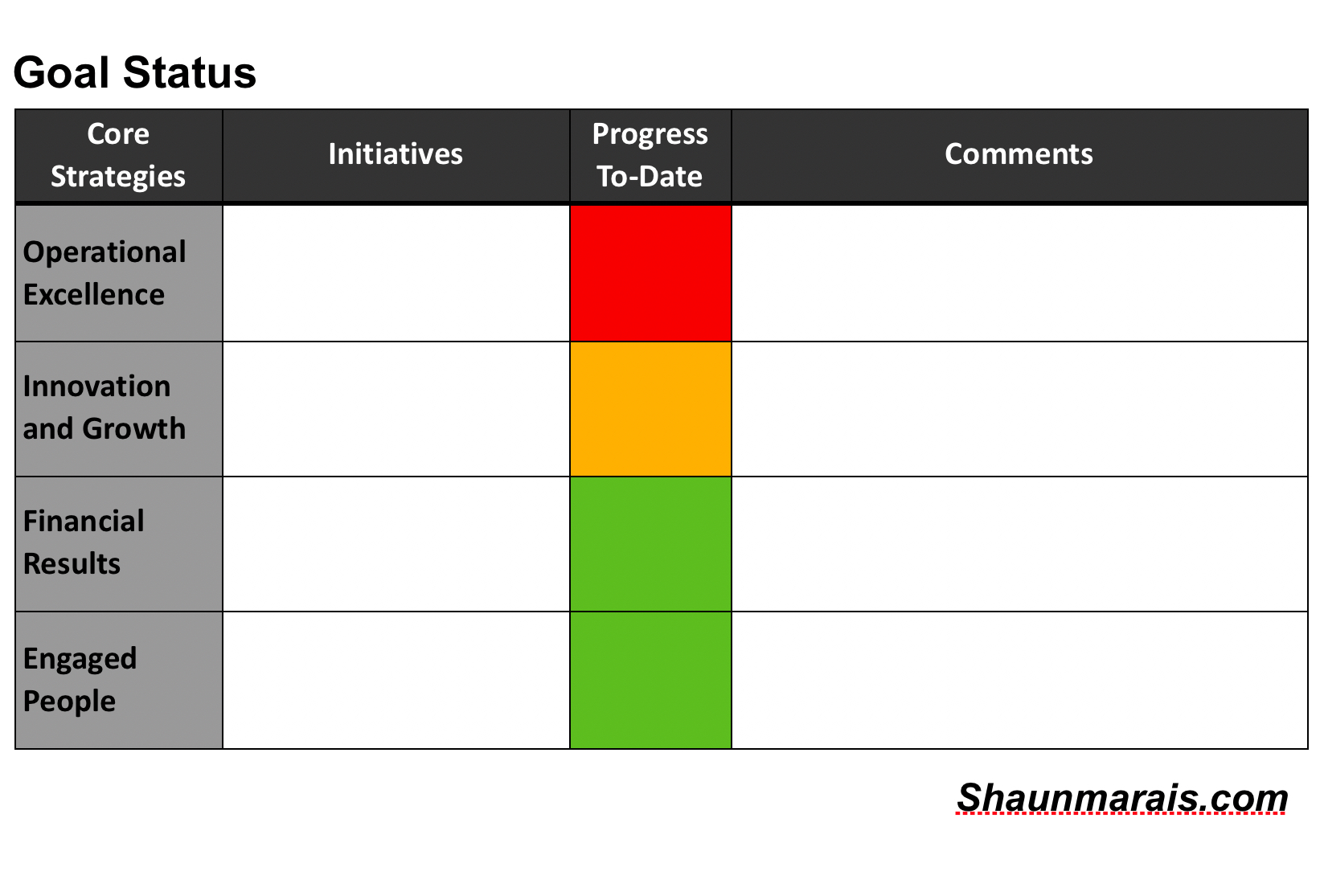
- Get a quick overview of the performance of different teams against goals and activities such as operational excellence, innovation, growth, financial results, and employee engagement by reviewing or creating a goal status document.
- Employee surveys provide valuable insights into company culture and the required leadership development activities to shift the culture.
- Use strategy summary ratings to evaluate your unit against strategic priorities using a rating of 1-5. This is self-rating tool can help identify focus areas.
| Strategic priority | 1 | 2 | 3 | 4 | 5 |
| Priority 1 | x | ||||
| Priority 2 | x | ||||
| Priority 3 | x |
- Conduct a SWOT analysis to identify strengths, weaknesses, opportunities, and threats
- Human Resources (HR) is a crucial support area in the business. First, you need to understand your HR structure and the level of technical integration in terms of the HR services available to employees. Any innovation in support areas comes at a cost, but automation and digital tools can also help reduce costs. Ensure that you have the right staff in place to support the deliverables for each business unit.
- Strategy workshops can align leaders on the business’s key outcomes. Beyond problem-solving, take time to celebrate wins and reflect on strengths and weaknesses. Review the planning documentation and assess how the company has met the initial targets and goals. Ensure SMART goals and clear actions are part of the key outcomes.
- At a unit level, develop propositions that describe the unit’s overall B2B value. Review the unit goals and track them against specific, measurable metrics (Flesher, n.d).
If you found this article useful, why not check out my other business tools.
References
Watkins, M. D. (2013). The first 90 days: Proven strategies for getting up to speed faster and smarter (Updated and expanded edition). Harvard Business Review Press.
Flesher, J. (n.d.). Strategic leadership and management capstone [Online course]. University of Illinois. Coursera. https://www.coursera.org
